
What to Expect
Conflict can arise in many forms — personal, familial, financial, or professional. Fairway Mediation provides a neutral, supportive environment where all parties have space to be heard and work toward resolution.
Mediation is a voluntary, agreement‑based process. Rather than placing decisions in the hands of a judge, mediation allows participants to remain in control of outcomes while benefiting from experienced guidance and structure. The Oregon Judicial Department describes mediation as a process where resolution occurs only if the parties themselves agree, with the mediator acting as a neutral facilitator rather than a decision‑maker or advocate.
Our approach emphasizes:
-
Respectful communication
-
Practical problem‑solving
-
Clear documentation of agreements
-
Emotional steadiness during difficult discussions
Sessions are available in person or virtually, depending on client needs.

Control
Agreements are created by the participants, not imposed by a court

Efficiency
Often faster and less costly than litigation

Privacy
Discussions occur in a confidential setting

Flexibility
Solutions can be tailored to the people involved

Lower stress
A calmer alternative to adversarial legal processes
The Matthew 18 Process
Resolving Disputes Biblically
At Fairway Mediation, we believe in resolving disputes with integrity, compassion, and a focus on restoring relationships. For those seeking a faith-based approach, we draw inspiration from the Matthew 18 principle, a biblical framework for resolving interpersonal conflict and disputes. This process emphasizes reconciliation and understanding before escalating issues to formal arbitration or legal proceedings.


What is the Matthew 18 Process?
The Matthew 18 principle, outlined in Matthew 18:15-17, provides a step-by-step guide for resolving conflicts in a way that prioritizes peace and restoration. It is a cornerstone of Christian conciliation and encourages individuals to address disputes privately and respectfully before involving others.
The 3-Step Matthew 18 Process
-
Private Confrontation
Begin by discussing the grievance one-on-one, in private, with the goal of reaching an understanding and restoring the relationship. This step emphasizes personal accountability and open communication. -
Bring Witnesses
If the private conversation does not resolve the issue, involve one or two neutral and respected individuals. These witnesses act as mediators or impartial observers to help facilitate a solution and ensure fairness. -
Escalate to Leadership
If the dispute remains unresolved, bring the matter before the broader community or church leadership for final adjudication and reconciliation. This step ensures that all efforts for resolution have been exhausted before considering further action.
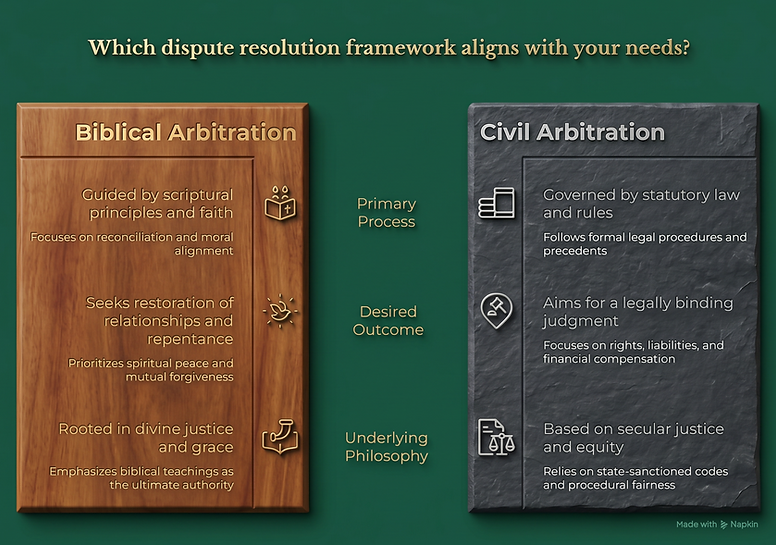
Biblical Arbitration vs. Civil Arbitration
The Matthew 18 Process forms the foundation of Christian Conciliation, a faith-based alternative to traditional legal proceedings. This approach encourages believers to resolve disputes within their community rather than resorting to civil courts. If reconciliation efforts fail, Christian arbitration provides a binding resolution that aligns with biblical principles.
For those seeking a more traditional approach, civil arbitration involves:
-
Filing & Case Management: Initiating the claim and outlining schedules and fees.
-
Arbitrator Selection: Agreeing on a neutral third-party arbitrator.
-
Discovery & Hearings: Exchanging evidence and holding a final hearing.
-
The Award: The arbitrator issues a legally binding decision in lieu of a court judgment.
At Fairway Mediation, we offer both faith-based and secular mediation services, tailoring our approach to meet your unique needs.

Why Choose Fairway Mediations?
Whether you are seeking a biblical approach to conflict resolution or a more traditional mediation process, Fairway Mediations is here to guide you every step of the way. Our goal is to help you achieve peace, understanding, and resolution in a way that honors your values and restores relationships.